Lab Grown Diamond Price Drop 2026: How Much Have Prices Actually Fallen?
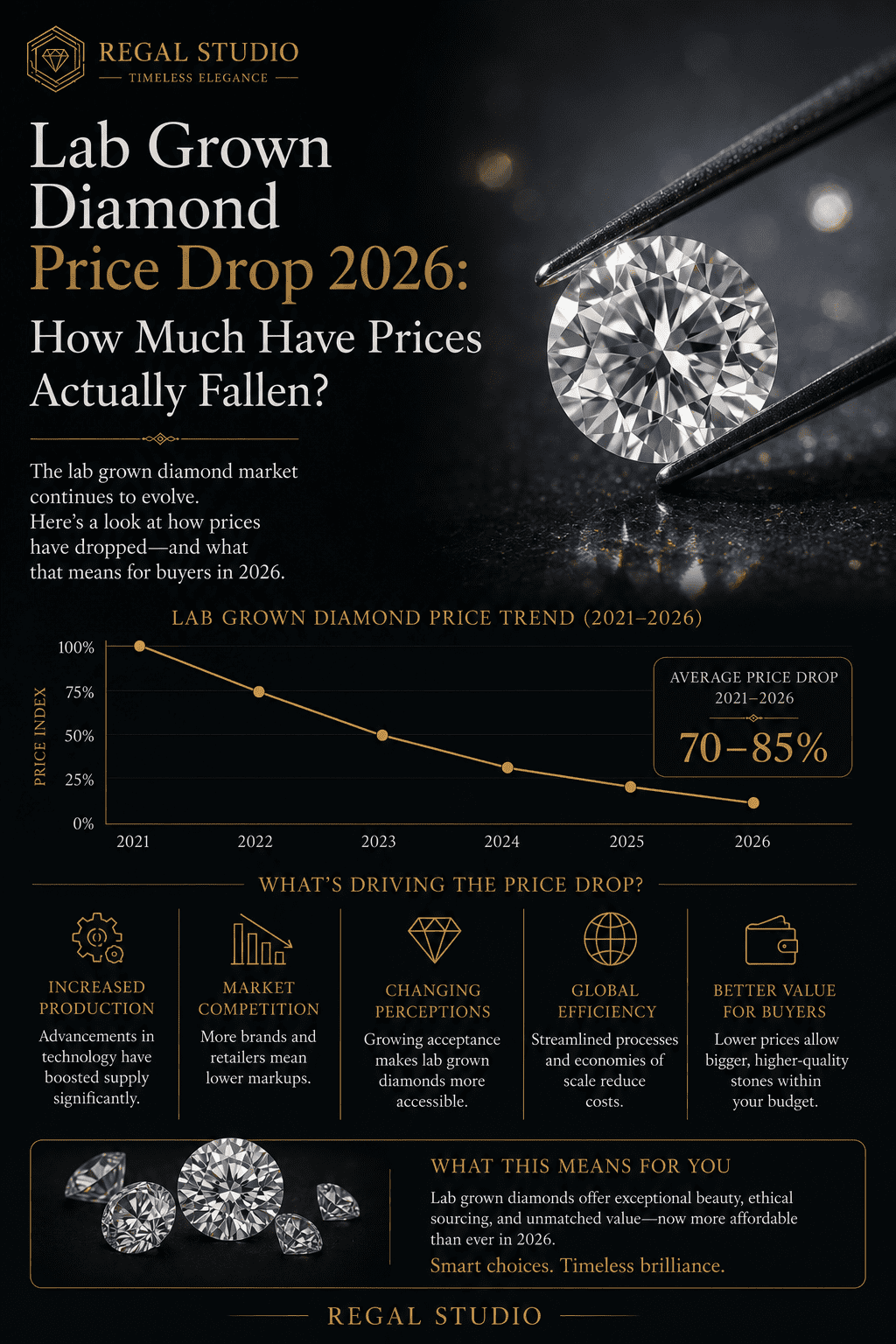
Quick answer: Lab grown diamond prices have fallen roughly 85–88% since their 2020 peak, with a 1-carat round dropping from about $3,410 per carat to near $400–$725 per carat by mid-2026. But here is the part most buyers miss: the dramatic free-fall is over. In 2026, prices have flattened, the steepest declines are behind us, and the market has reached a production-cost floor for premium certified stones.
So if you have been waiting for prices to crash further before you buy, our experience at the bench tells us that waiting is no longer worth it.
A Note on Where This Analysis Comes From
Before the numbers, a word on perspective. This guide is written from the vantage point of Regal Studio in Buckhead, Atlanta.
Our founder, Mack, is a GIA Certified Diamond Grader with over 45 years at the bench. We have graded, set, and sourced diamonds through every phase of the lab grown era.
So when we talk about price movement, we are not summarizing headlines. We are reporting what we see cross our counter every week.
The Short History of a Historic Price Collapse
To understand 2026, you have to understand how we got here. Few luxury products in modern history have lost value this fast.
A 1.5-carat lab grown diamond that sold for roughly $10,300 in 2016 was worth about $3,975 by 2021. By early 2025, the per-carat wholesale figure had fallen to around $168.
That is not a gentle decline. That is a collapse.
The cause was not a loss of quality. The diamonds got better. The cause was supply.
- Global production capacity grew by over 300% between 2020 and 2023.
- New CVD and HPHT factories in China and India scaled aggressively.
- An inventory overhang flooded the market faster than it could sell.
Experience has shown that when supply triples and demand grows only steadily, price has one direction to go. And it went there fast.
Lab Grown Diamond Price Drop 2026: The Real Numbers
Here is what the data actually shows for 2026. We have cross-referenced benchmark figures from multiple retail and wholesale trackers against what we see in our own sourcing.
Price Decline Timeline (1-Carat Round, IGI Certified)
Year | Approx. Retail Price (per carat) | Notable Driver |
2016 | ~$6,800+ | Early-stage, limited supply |
2020 | ~$3,410 | Pre-collapse baseline |
2021 | ~$2,650 | COVID supply disruption |
2024 | ~$900–$1,000 | Mass production hits scale |
Q1 2026 | ~$400–$725 | Approaching cost floor |
A key insight often overlooked: the biggest single-year drops are now behind us. Q1 2026 recorded the smallest quarterly decline in eight consecutive quarters. The curve is flattening, not falling off a cliff.
What This Means in Plain Terms
- A 1-carat lab grown diamond today averages roughly $725 retail (round cut), with ovals near $800.
- A 2-carat round sits in the $1,700 range.
- The gap between cheap uncertified stones and premium certified goods has widened.
In our market observations here in Atlanta, the price floor belongs to uncertified, lower-purity material. Certified stones with strong cut grades hold their ground far better, which is why we will not stock anything else.
Why Did Lab Grown Diamond Prices Fall So Much?
There is no single villain here. Three forces stacked on top of each other.
1. Manufacturing Got Radically More Efficient
CVD (Chemical Vapor Deposition) and HPHT (High Pressure High Temperature) technology matured fast. Stones now grow in months, not eons, with consistent clarity, color, and cut. Lower production cost flows straight into lower retail prices.
2. Supply Outran Demand
More factories meant fierce competition. Basic economics took over. At the peak of the glut, prices fell about 20% in a single year.
3. There Is No Rapaport for Lab Grown
Natural diamonds follow the globally accepted Rapaport price list. Lab grown stones have no universal pricing benchmark.
This is why the same 1-carat DEF VVS1 stone can be priced wildly differently from one seller to the next. The absence of a standard accelerated the race to the bottom and, frankly, created room for a lot of overpricing.

Lab Grown vs Natural Diamond Prices in 2026
This is where the story gets genuinely useful for buyers. The gap between lab grown and mined diamonds is now enormous, and it still widens at larger carat sizes.
Price Comparison Table (Comparable Quality, US Retail)
Stone Size | Natural Diamond | Lab Grown Diamond | Approx. Savings |
1 carat (D/VVS2) | ~$4,500–$6,500 | ~$450–$725 | 85–90% |
2 carat (excellent specs) | ~$15,000–$20,000 | ~$3,500–$5,000 | ~75% |
3 carat (D/VVS2) | ~$40,000–$70,000 | ~$1,700+ (set) | 90%+ |
A key insight often overlooked: the bigger the stone, the bigger the discount. Lab grown prices do not scale exponentially with carat weight the way natural diamonds do.
This changes what is possible, not just what is cheaper. A 3-carat center stone that would be out of reach for most couples in natural form becomes entirely achievable lab grown.
By industry estimates, lab grown stones now sell at an 80–90% discount to mined diamonds of comparable quality.
The 2026 Wild Card: Tariffs and the Supply Chain
Here is something the generic price guides rarely flag, and it matters for what you will pay at retail this year.
In 2026, a new variable entered the equation. The United States imposed steep tariffs on diamonds shipped from India. At one point, 50% tariffs caused cut-and-polished shipments from India to the US to fall by roughly 60%.
An interim US–India trade agreement in early 2026 brought that down to 18%. But loose lab grown diamonds are not covered under the duty-free provisions.
What does this mean for you?
- This added cost may offset some of the ongoing wholesale price drops.
- It is a major reason 2026 retail prices have stabilized rather than kept falling.
- Expect short-term price firmness at the retail level through the rest of the year.
Experience has shown that trade policy can move prices faster than manufacturing ever could. We are watching this one closely.
Should You Buy a Lab Grown Diamond in 2026?
This is the question behind every price search. Here is our honest read, the same one we give clients across the counter in Buckhead.
Buy now if you want maximum beauty and size for your budget. Prices are at or near historic lows, and waiting for another big crash is, in our assessment, a losing bet.
Be clear-eyed about resale. A lab grown diamond is not an investment. If you buy one and try to sell it later, you may recover only 10–30% of what you paid. Think of it like a car, not gold. You buy it to wear and to mark a moment, not to flip.
A few practical tips from 45 years at the bench:
- Always insist on IGI or GIA certification. Uncertified stones are where the real price erosion lives.
- Prioritize cut over chasing a flawless clarity grade. Cut drives brilliance; nobody sees VVS versus VS with the naked eye.
- G or H color is the smart value sweet spot for most buyers once the stone is set in metal.
- Watch the setting, not just the stone. Many sellers protect margins by quietly upselling the mounting.
Where Are Lab Grown Diamond Prices Heading Next?
Our forward view, grounded in current data and what we see in sourcing:
- Per-carat prices are near the bottom. Major additional drops in 2026 are unlikely.
- The overall market is still growing on volume, not price. One forecast values the global lab grown market at nearly $29.5 billion in 2025, projected to top $90 billion by 2034.
- Certification and craftsmanship, not raw market decline, will drive value going forward.
Translation: the era of “wait six months and save thousands” is over. The smart move now is to optimize for quality, cut, and trust, not timing.

Frequently Asked Questions
How much have lab grown diamond prices dropped by 2026?
Retail prices have fallen approximately 85–88% since 2020, from around $3,410 per carat to roughly $400–$725 per carat for a 1-carat round. Measured from the 2018 peak, the drop is closer to 90%.
Will lab grown diamond prices keep dropping in 2026?
Unlikely at the same pace. The market has reached a production-cost floor for premium certified stones, and 2026 has shown the smallest quarterly declines in two years. New tariffs are also adding upward pressure at retail.
Are lab grown diamonds cheaper than natural diamonds in 2026?
Yes, dramatically. Lab grown stones cost roughly 80–90% less than comparable natural diamonds, and the discount grows larger at higher carat weights.
Do lab grown diamonds hold their value?
No. They are not a financial investment. Resale typically recovers only 10–30% of the purchase price. Buy a lab grown diamond for beauty and meaning, not for return.
Is 2026 a good time to buy a lab grown diamond?
Yes. Prices are at historic lows and have stabilized. Waiting for a further major crash is not a sound strategy, since the steepest declines are already behind us.
Talk to a GIA Certified Diamond Grader in Atlanta
Prices have settled, but quality, certification, and trustworthy sourcing still vary wildly from seller to seller. That is exactly where real expertise pays for itself.
At Regal Studio in Buckhead, every piece is designed and handcrafted by Mack, a GIA Certified Diamond Grader with over 45 years of experience. We will help you compare certified lab grown stones, decode the 4Cs, and find the right diamond for your budget without overpaying for inflated grades.
Our motto says it all: “You Dream It, We Make It.”
Visit Regal Studio on Peachtree Road in Buckhead, or get in touch to book a consultation. Let a seasoned master jeweler guide you through it personally.
Read More:
Women’s Custom Engagement Ring Styles in Atlanta: Gold, Lab Diamond, and One-of-a-Kind Designs
Moissanite vs Diamond: Is It Worth the Savings or Will You Regret It?